Head Injury Risk Prompts Recall of Basecamp Bicycle Helmets
 Linda H.
Advertisement
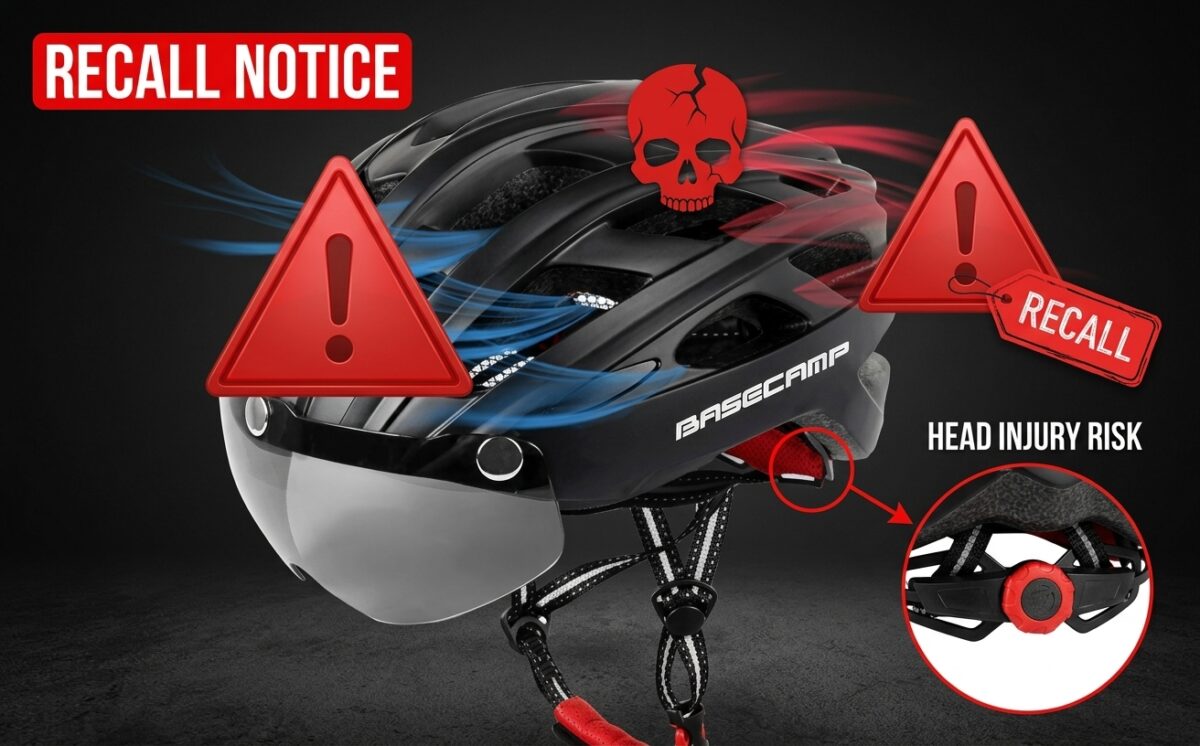
A bicycle helmet meant to protect riders from head trauma may instead leave them exposed in a crash. Tongyang Cycling, doing business as HK Tongyang Technology Co., Ltd. of China, has recalled its Basecamp-branded bicycle helmets after the U.S. Consumer Product Safety Commission determined the headgear fails to meet the mandatory federal safety standard for bicycle helmets.
Read Also
The recall, announced September 17, 2026, covers about 215 units sold in the United States. The helmets do not comply with impact attenuation, positional stability and certification requirements set out in the federal standard, meaning they may not adequately cushion or stay in place during a fall or collision.
What Products Are Being Recalled?
The recall involves Basecamp-branded bicycle helmets, model HT-10, sold in green and black. They come in a single size, medium/large (M/L), designed to fit head circumferences of roughly 22.44 to 24.41 inches. Distinguishing features include red interior padding, black and red straps, a black and red buckle, and a black and red fit-adjusting knob at the back of the helmet. The word ‘Basecamp’ is printed on the sides, while ‘HT-10’ appears on an internal label.
The helmets were sold exclusively online at Amazon.com from July 2024 through July 2026, at a price of about $34.
Advertisement
Read Also
Why Was This Recall Issued?
According to CPSC, the helmets violate the mandatory bicycle helmet safety standard because they do not meet impact attenuation, positional stability, and certification requirements. In plain terms, that means the helmets may not sufficiently absorb the force of an impact or stay properly positioned on a rider’s head, which ‘can fail to protect the user in the event of a crash, posing a serious risk of injury or death due to head injury,’ the agency said.
A second issue compounds the danger. The helmets contain a button cell battery, likely for an integrated light or safety feature, that lacks the warning labels required under Reese’s Law, the 2022 federal mandate aimed at preventing button battery ingestion injuries in children. If swallowed, button cell or coin batteries can cause severe internal chemical burns and, in some cases, death.
Who Is Affected?
Because the helmets were sold only through Amazon.com, the recall’s reach is nationwide rather than tied to specific states or retail chains. Anyone who purchased a Basecamp HT-10 helmet through that listing between July 2024 and July 2026 should check their equipment against the recall description. No injuries or incidents have been reported to date, according to CPSC, but the agency is urging swift action given the severity of the potential harm.
What Should You Do?
If you own one of these helmets, stop using it right away. Continuing to ride with a helmet that does not meet federal impact standards leaves you without reliable head protection in a crash.
Consumers should contact Tongyang Cycling directly to arrange a full refund. The company can be reached by email at tongyangshangwuus@hotmail.com, or through its website at basecampbike.com, where clicking the ‘Recall’ link at the top of the page provides further instructions. As part of the remedy process, owners will be asked to destroy the helmet by cutting its straps, photograph the destroyed unit, and send that photo to the company before disposing of the product.
Because the helmet contains a button cell battery, it should not simply be thrown in household trash. CPSC advises that these batteries are hazardous and should be disposed of or recycled according to local hazardous waste procedures.
Official Statement
CPSC’s published notice states plainly that the recalled helmets ‘can fail to protect the user in the event of a crash, posing a serious risk of injury or death due to head injury,’ underscoring why the agency moved to have the product pulled from the market despite the absence of reported incidents so far. The recall is listed under CPSC recall number 26-785.
Official Source: View original notice on CPSC →
Advertisement