Health Canada Orders Recall of Philips Ingenia, Achieva, Intera MRI Systems
 Linda H.
Advertisement
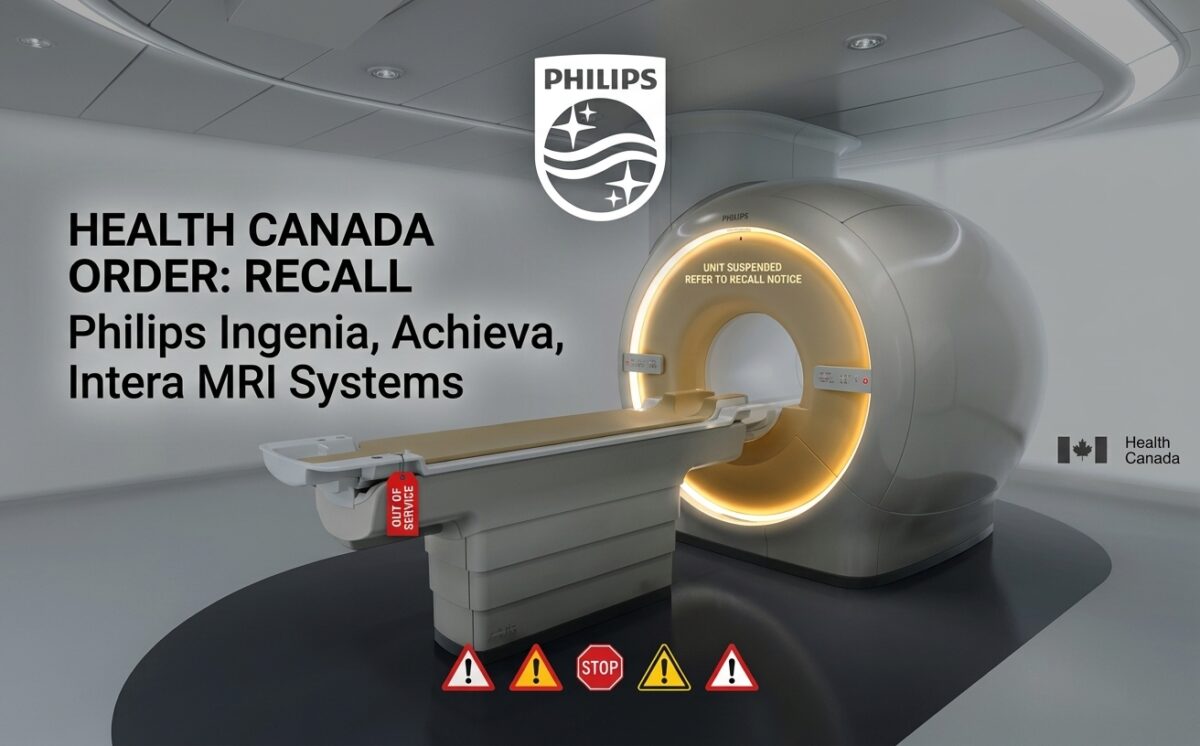
Health Canada has issued a Type II medical device recall covering several Philips Ingenia, Achieva and Intera MR System models after discovering a software issue that can distort diffusion tensor imaging (DTI) data used to map nerve pathways in the brain. The recall, dated September 4, 2026 and published September 17, 2026, was assigned identification number RA-82636 and applies to hospitals and imaging centres using the affected scanners, not individual consumers.
Read Also
The issue centers on how these MR systems export DTI scans using the Enhanced MR DICOM format. According to Health Canada, when facilities export scans in this format and then feed them into third-party software for tractography, the exported files contain incorrect diffusion direction data. Tractography software uses this data to reconstruct nerve fiber pathways, a technique widely relied upon in neurosurgical planning and neurological research.
Products Affected by This Recall
The recall covers a specific list of Philips MR system models, identified below by their model or catalogue number. Health Canada notes that lot or serial numbers are ‘not applicable’ for these units, meaning the issue affects the systems by model rather than by individual production batch.
- Intera 1.5T MRI System (Main Unit) — Model INTERA 1.5T
- Ingenia Ambition X — Model 782109
- Ingenia Ambition X — Model 782138
- Ingenia 3.0T CX — Model 781271
- Ingenia 3.0T — Model 3.0T
- Achieva 3.0T MRI System (Main Unit) — Model ACHIEVA 3.0T
- Ingenia Elition X — Model 782136
- Ingenia Elition X — Model 781358
What Went Wrong?
Health Canada’s notice explains that when diffusion tensor imaging scans are exported from these MR systems in the Enhanced MR DICOM format, the diffusion direction values embedded in the export are incorrect. Since tractography software depends on accurate directional data to reconstruct how nerve fibers run through brain tissue, the flawed export prevents that reconstruction from being processed correctly.
Advertisement
Read Also
This is a data-integrity problem rather than a scanning malfunction. The MR systems themselves are not reported to produce inaccurate images during the scan itself; rather, the error appears specifically when the DTI data is exported for use with outside tractography programs, which many neurology and neurosurgery teams use for surgical planning and research purposes.
Who Should Be Concerned
This recall is directed at healthcare facilities and clinical staff who operate Philips Ingenia, Achieva or Intera MR systems and who export DTI scans in the Enhanced MR DICOM format for use with third-party tractography software. Health Canada lists the intended audience for this alert as healthcare professionals, and the manufacturer, Philips Medical Systems Nederland B.V., is based in Best, Netherlands.
Patients themselves are not being asked to take any direct action, since this is a facility-level equipment and software issue rather than a product recalled from consumer shelves. However, clinicians relying on tractography results generated from affected exports should be aware that reconstructions may be unreliable until the issue is addressed.
What Should You Do?
Health Canada’s guidance for this recall is straightforward: facilities and users who require additional information should contact the manufacturer directly. No refund, return, or consumer remedy process applies, since the affected products are large hospital-based imaging systems rather than retail goods.
Institutions using any of the listed Philips MR system models are encouraged to review their DTI export workflows, particularly where Enhanced MR DICOM exports feed into third-party tractography tools, and to reach out to Philips Medical Systems Nederland B.V. for guidance on mitigating the data error while a permanent fix is implemented.
From the Agency
Health Canada classified the action as a Type II recall and published the alert under its medical devices recall program, with the affected category listed as ‘Health products – Medical devices – Radiology.’ The agency’s notice states plainly that the Enhanced MR DICOM export issue affects diffusion direction data, and that when paired with third-party tractography software, ‘the software will not be able to correctly process the DTI data for reconstruction.’ Updated details, if any, will appear on the official Canada.ca recalls and safety alerts database.
Official Source: View original notice on Health Canada →
Advertisement