Fire Risk Prompts Recall of Cambridge Audio Yoyo (M) Speakers 2026
 Linda H.
Advertisement
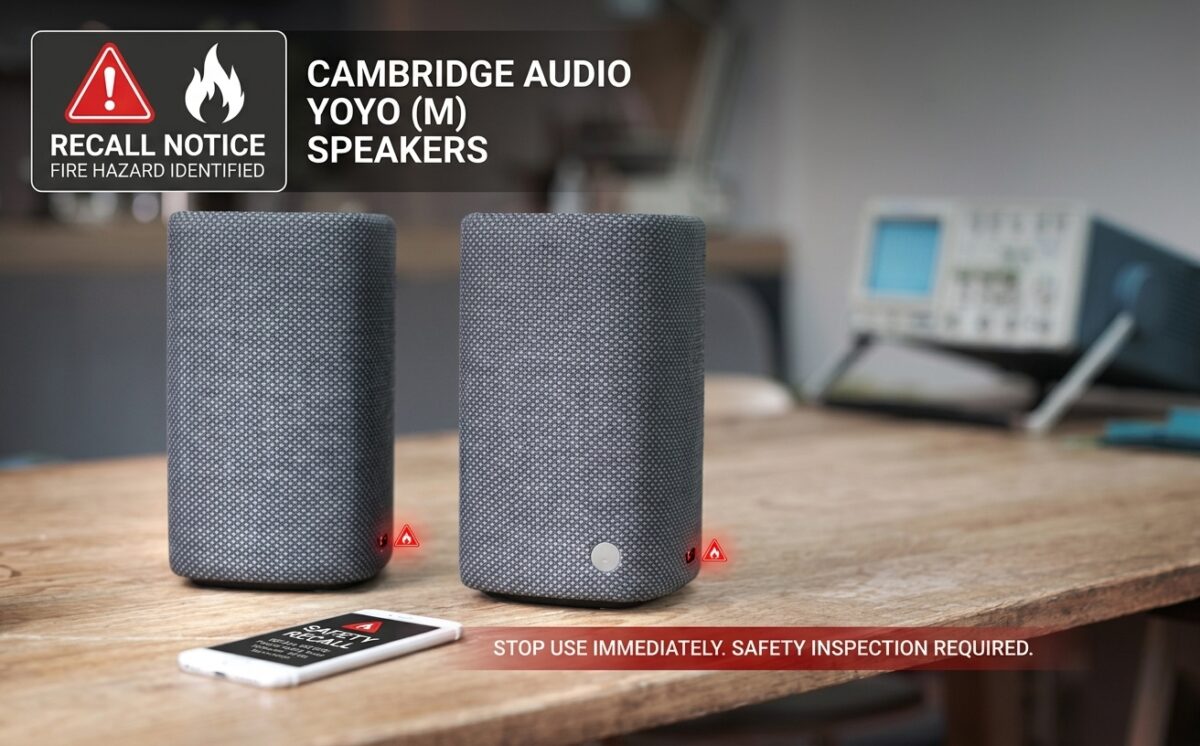
A lithium-ion battery defect that can cause overheating has triggered the recall of roughly 714 Cambridge Audio Yoyo (M) portable Bluetooth speakers, according to the U.S. Consumer Product Safety Commission. The batteries inside the speakers can overheat and ignite, posing a genuine fire hazard to anyone who owns one of the affected units.
Read Also
The recall was announced on September 3, 2026, by Audio Partnership Plc, the England-based manufacturer, working with its U.S. distributor, Audio Partnership, LLC, of Clearwater, Florida. The company has already received four reports of incidents involving fire, smoke and battery material being ejected from the speakers. No injuries have been reported so far, but the CPSC and the firm are urging consumers not to take chances with the product.
What Products Are Being Recalled?
The recall covers the Cambridge Audio Yoyo (M) Bluetooth speaker, sold in pairs in three colors: light gray, dark gray and blue. Consumers can identify the recalled units by the product name ‘Yoyo (M)’ printed on the speaker and by an FD number stamped on the underside of each unit.
- Dark Gray – UPC 8 13371 02296 6 – FD No. FD C10931 XXXX XXXX
- Light Gray – UPC 8 13371 02295 9 – FD No. FD C10930 XXXX XXXX
- Blue – UPC 8 13371 02492 2 – FD No. FD C10965 XXXX XXXX
The speakers were sold at specialty stores nationwide and online at cambridgeaudio.com, Amazon.com and eBay from 2016 through 2022, with prices ranging from $172 to $218. The product was manufactured in China.
Advertisement
Read Also
Why Was This Recall Issued?
The core issue lies in the lithium-ion battery packs powering the speakers. Over time, or under certain conditions, these batteries can overheat, and in some cases that overheating has escalated into fire, visible smoke, or the violent ejection of battery material from inside the unit. That is a serious concern for any product that spends time charging unattended in a home, office or car.
Four such incidents have already been documented by the firm, though the CPSC notes that none have resulted in injury to date. Still, the pattern was enough to prompt a formal recall rather than wait for a more serious outcome.
Who Should Be Concerned
Anyone who purchased a Cambridge Audio Yoyo (M) speaker between 2016 and 2022, whether from a specialty audio retailer or online through Cambridge Audio’s own site, Amazon or eBay, should check their unit against the color and FD number details above. Because the speakers were sold broadly across the United States and online, the affected population is nationwide rather than limited to a specific region.
What Consumers Need to Do Now
If you own one of these speakers, stop using it right away. Disconnect it from any power source, stop charging it, and store it away from anything combustible until you can arrange for its return.
From there, contact Audio Partnership to arrange your remedy. Consumers are offered a choice: a full cash refund of $218, or a Cambridge Audio online store voucher worth $350. Once the company processes the claim, it will provide instructions on properly disposing of the unit.
Because this product contains a recalled lithium-ion battery, it should never be thrown in household trash, placed in curbside recycling bins, or dropped into standard used-battery recycling boxes at retail or home improvement stores. These batteries carry an elevated fire risk and require specialized handling. Consumers should check with their municipal household hazardous waste collection center to confirm it accepts recalled lithium-ion batteries before bringing the unit in; if it does not, contact the municipality for further guidance.
What the Company Said
Audio Partnership has stated that consumers may reach the company toll-free at 888-805-5001, from 9 a.m. to 5 p.m. ET, Monday through Friday, or visit the dedicated recall page at cambridgeaudio.com/usa/en/product-recall and select the link for the Yoyo (M) product to begin the refund or voucher process. This recall was carried out as a CPSC Fast Track Recall and carries the recall number 26-731.
Official Source: View original notice on CPSC →
Advertisement