FDA Classifies BMC Medical’s Luna G3 APAP Recall as Class I Risk
 Linda H.
Advertisement
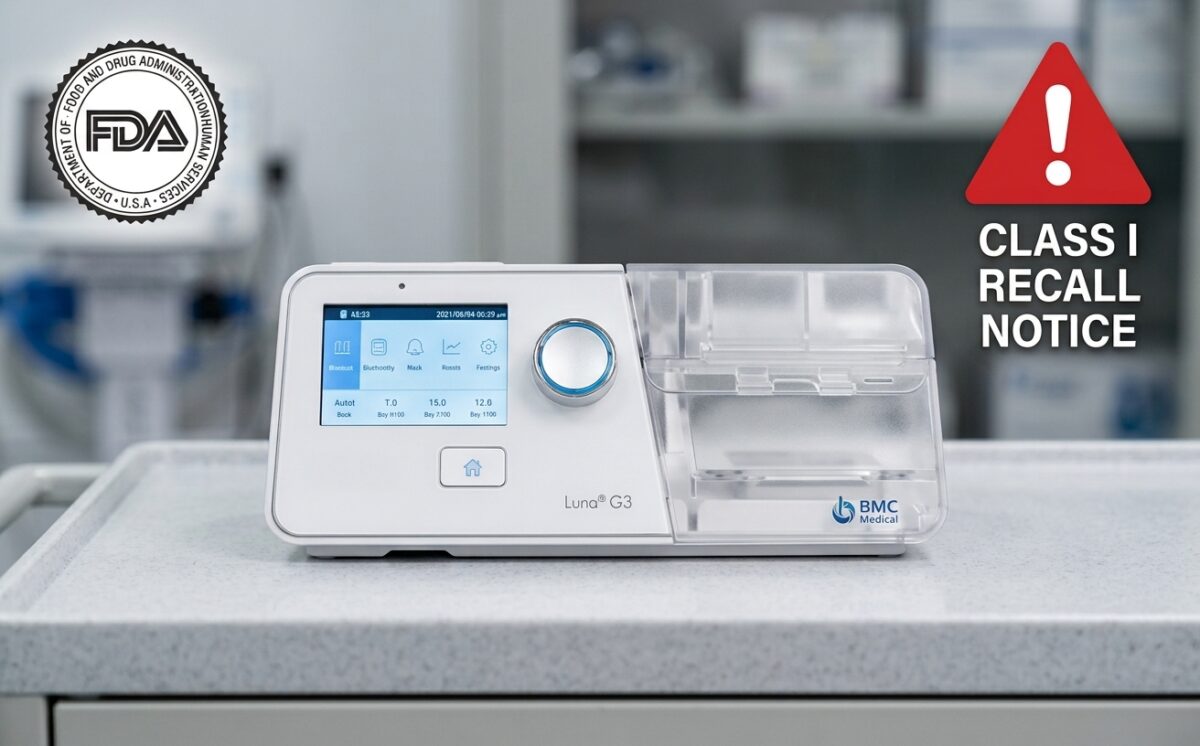
The U.S. Food and Drug Administration has classified a recall of BMC Medical Co., Ltd.’s Luna G3 APAP (Model LG3600) breathing therapy devices as a Class I recall, the agency’s most serious designation, reserved for situations where continued use could cause serious injury or death. The action affects 20,160 devices distributed nationwide, after the company discovered a firmware defect that can cause the machine to shut down mid-therapy without warning.
Read Also
BMC Medical, based in Beijing, China, retrospectively reported the recall to the FDA on July 15, 2026. The FDA reviewed the report and assigned it Class I status on August 19, 2026, under recall number Z-2979-2026. Notably, the company’s original corrective action was never communicated directly to patients or customers who owned the affected devices.
What Products Are Being Recalled?
The recall covers the Luna G3 APAP, Model LG3600, a positive airway pressure device used to treat sleep apnea. Affected units carry Unique Device Identifiers 06948538363331 and 06948538365892 and run firmware version G3-2.00.76. The devices were manufactured between September 11, 2024, and October 18, 2024, and shipped by BMC to its U.S. importer, React Health, from September 20 through October 19, 2024. From there, units reached patients and providers across the country between October 29, 2024, and July 6, 2026.
Why Was This Recall Issued?
BMC identified a defect in firmware version G3-2.00.76. If a device running this firmware simultaneously encounters high pressure, a high respiratory rate, and a high peak flow, it displays an ‘Error’ message and automatically shuts down, cutting off therapy delivery entirely. For someone relying on the machine overnight to manage sleep apnea, an unannounced shutdown could mean hours without treatment.
Advertisement
Read Also
BMC says it upgraded the firmware to version G3-2.00.77 on the 20,160 affected devices while they were still held at the U.S. importer’s warehouse, completing that work between October and December 2024. However, after filing its retrospective recall report, the company discovered that as many as 196 units may have slipped through without receiving the update and could still be running the defective G3-2.00.76 firmware. The FDA notes that unintended serious adverse health consequences are possible, though BMC states it has not received any complaints or adverse event reports tied to the defect so far.
Who Should Be Concerned?
Anyone currently using a Luna G3 APAP (Model LG3600) should check whether their unit is among those that may have missed the firmware fix. Because the original correction was never announced to end users, many patients using the device today may be unaware their machine was ever part of a recall.
What Should You Do?
Owners of the Luna G3 APAP can verify their firmware version by locating the serial number printed on the label at the rear of the device, then visiting BMC’s online lookup tool at en.bmc-medical.com/rc-adh.html, entering the serial number, and clicking ‘Check My Device’ to see the firmware version currently installed.
Patients can also consult their physician or Durable Medical Equipment provider to confirm whether their specific device is safe to continue using. Any device still running firmware version G3-2.00.76 should be discontinued immediately until a replacement is provided. To request a replacement, customers should contact React Health, BMC’s U.S. importer, by email at 3B-Recall@reacthealth.com, or by phone at 863-226-6285, Monday through Friday between 8:00 a.m. and 5:00 p.m. Eastern Time. BMC can also be reached at any time by email at bmc-recall@bmc-medical.com.
Official Statement
The FDA notes it is posting BMC’s company announcement as a public service and does not endorse the product or the company involved. Adverse reactions or quality problems linked to the device can be reported to the FDA’s MedWatch program by phone at 1-800-332-1088, online through the MedWatch reporting portal, or by mailing or faxing a downloadable form to 800-332-0178.
Official Source: View original notice on FDA →
Advertisement